
The Psychotherapy and Philosophy of Grief
What does it mean to grieve healthily? What do we grieve for?

Two recent threads in my life motivated this post.
The first is that grief and loss have become a small but significant part of my therapy practice. As such, I have gotten quite deep into reading about grief. Meaning-making has become a deep interest of mine, and grief is among the most meaningful experiences of all.
The second is that I recently finished the video game Clair Obscur: Expedition 33. It is a beautiful game about grief and loss. It is about how we cope with overwhelming personal disasters; about the multifaceted emotions of the grief response; and about being willing to do anything – anything at all – to cope with the pain of losing others.
I cannot be more effusive in praise about this game. It is SO fun, the visuals are SO pretty, and the music is SO good. Just give these a look/listen!



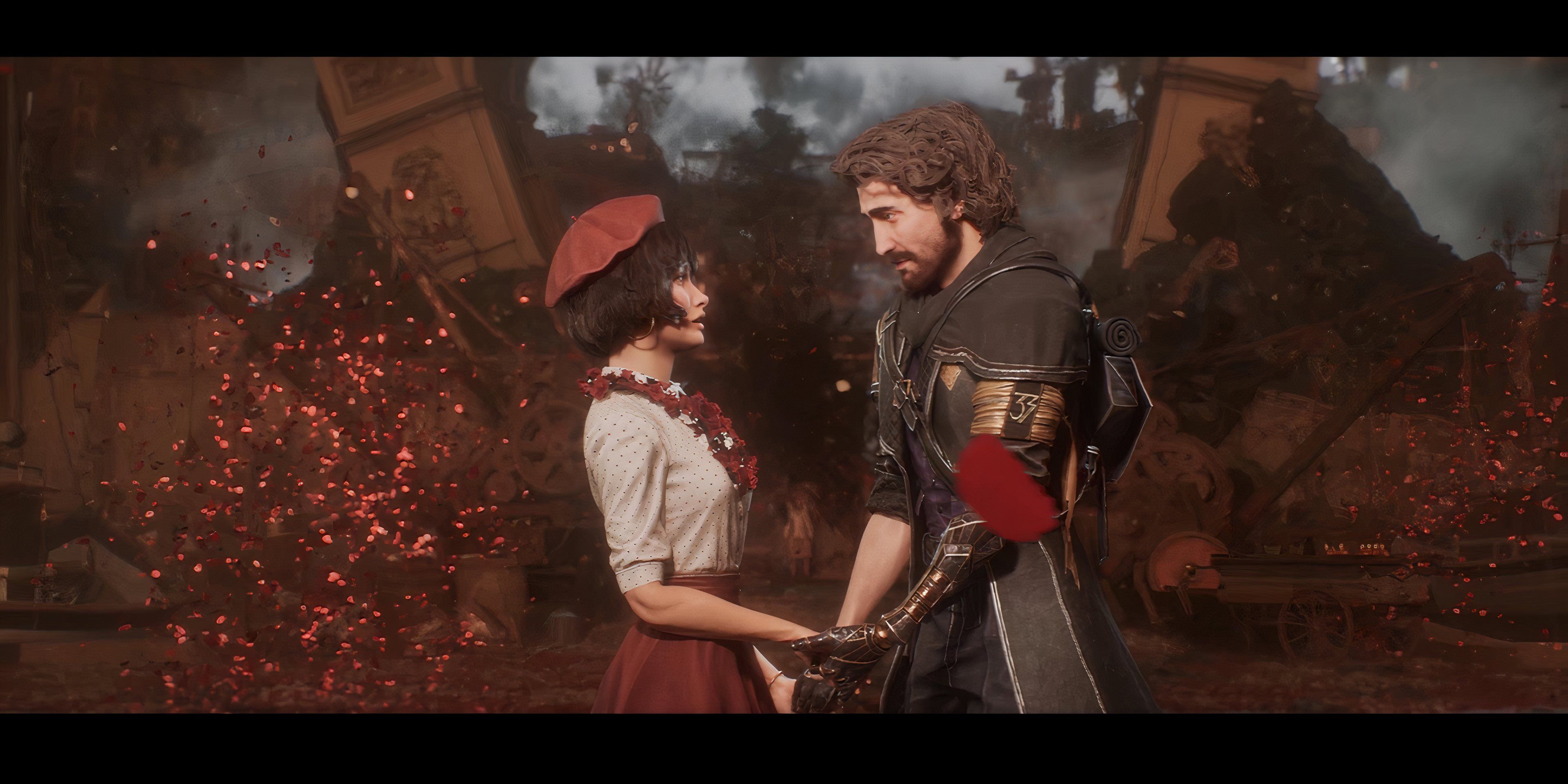
Many, many popular video essays have been coming out in recent months talking about the theme of grief in this wonderful game. However, to my knowledge, none have yet looked at the game explicitly through the lens of grief therapy or the philosophy of grief.
However, to set this analysis up, I must first introduce these concepts, and many of these will presumably be unfamiliar to you. That is what this first post is intended to do. In the next post (Grief Therapy and Grief Philosophy in Clair Obscur: Expedition 33), I will apply these concepts to analyzing Clair Obscur: Expedition 33. And while you wait for the next post, I hope you give the game a try!
In this Part 1 post, I aim to achieve four things.
Define grief from a psychological and philosophical perspective
Introduce Worden’s Tasks of Mourning and contrast it briefly with the Kübler-Ross Stages of Grief model (and why I prefer the former)
Discuss various insights from the philosophy of grief
Synthesize the insights from these two fields
WARNING: This is a LONG post, about 6000 words long. If you want to just read the basics needed for understanding Part 2, read the sections on Worden’s Tasks of Mourning and Brief Summary of the Philosophy of Grief. But if you’re willing to take the time to read the rest, I think you will take something valuable away from it! We will all have experienced grief sometime in our lives, and I think understanding it better may help you personally.
Psychotherapeutic and Philosophical Perspectives on Grief
A few quick notes before I dive into definitions: I am not going to pretend that these fields agree on what grief is, or even whether they have really understood grief at all. One major tension between the psychology and philosophy of grief is the question of whether grief should be considered a mental health issue at all. Many psychologists agree that severe grief can manifest as a mental health problem (such as major depression, PTSD, or the recently minted prolonged grief disorder). To some contrast, some philosophers are concerned at the medicalization of grief given that it is a normal human condition. While I share some of these philosopher’s concerns, I find myself primarily in the former camp: most grief is normal, but some grief can be disordered and lead to dysfunctions that we should intervene on. As such, I will move forward with the assumption that at least some grieving people could benefit from grief counseling and therapy.
Another note: while grief is often associated with death, I think many psychologists would argue that other kinds of loss (e.g., breakups, forced separations, moving away) lead to similar responses as death does. Although some of the language here will be talking about grief following a death, other kinds of loss maybe applicable as well.
Psychotherapy and Grief
William Worden (a pre-eminent grief psychologist) describes grief as a broad range of feelings, cognitions, physical sensations, and behavioral changes common after a loss. Feelings might include sadness, anger, guilt, numbness, pain and relief; cognitions might include disbelief, confusion, obsession, and a sense of presence (of the deceased); sensations might include hollowness, tightness, fatigue, sensitivity to noise, and depersonalization (“nothing feels real”); behaviors can include changes to sleep, eating, attention, socializing, dreams, and avoidance of reminders. These are common to normal grief. We expect these to manifest after a loss and continue for some time - the diagnostic manual by the American Psychiatric Association implies that normal grief can last up to 6 months. Importantly, no grief response is exactly the same - one person’s grief can look very different from another’s.
Complicated (or pathological) grief, in contrast, is defined by an intensification, non-termination, or premature interruption of grief leading to maladaptive (“unhelpful/unhealthy”) behavior. It may involve an excessive and disabling experience of grief; a chronic experience of grief lasting for several years; or an inhibited initial response to loss that eventually emerges with renewed intensity. This is the kind of grief many psychologists consider to be a mental disorder.
While grief is a process/experience, mourning is a behavior. Mourning is a process that involves taking actions to come to terms with a loss. This process has been variously theorized as a set of stages (made famous by Kübler-Ross), phases, and tasks. Worden endorses the task model and describes four tasks of mourning, which we will take up in the next section.
(These definitions are taken from Worden’s “Grief Counseling and Grief Therapy Handbook” [2018])
As I’ve said before, therapy is not only for people with mental health disorders. Even normal grief can cause symptoms, disrupt our functioning, or make us vulnerable to mental health problems - and it most definitely can interact with our meaning-making. All of these things can be worked on in therapy. Worden (2018) describes therapy for normal grief as grief counseling, while therapy for complicated grief is called grief therapy. When I refer to therapy generally, I am talking about both of these approaches. A therapist might apply either with a grieving person depending on the nature of their grief.
Worden’s Tasks of Mourning (and *sigh* the Kübler-Ross Stages of Grief, I guess)
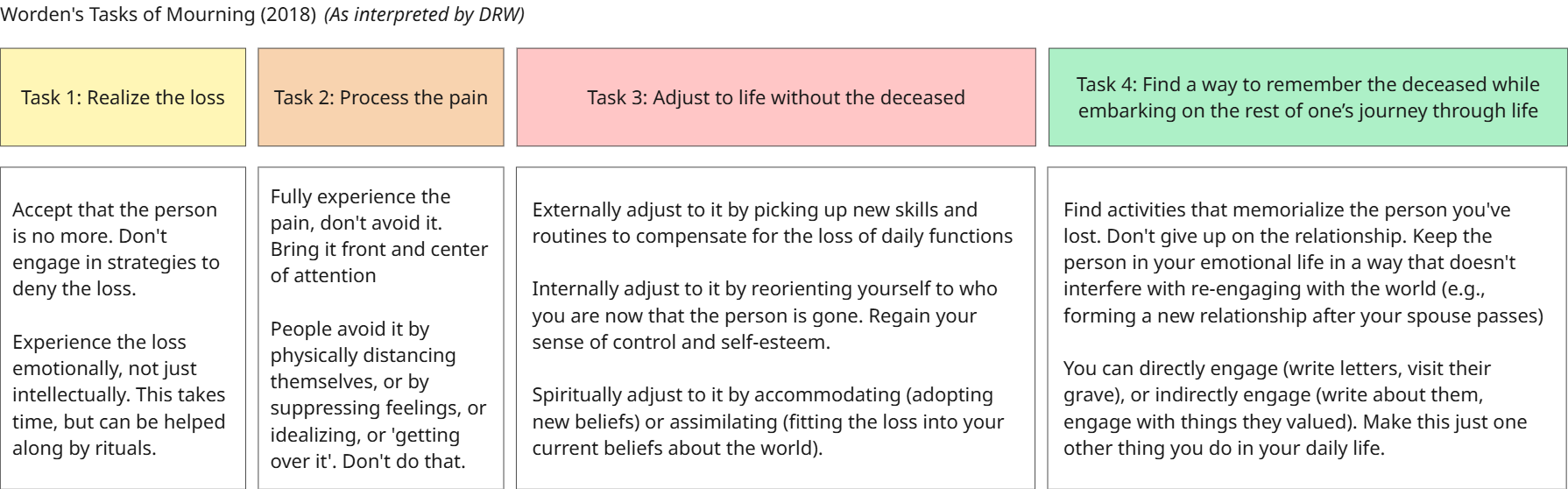
Worden describes the process of mourning as a set of tasks. He bases this on an understanding of grief as a matter of adaptation, or adjusting one’s self or activities to fit with the present circumstances. Since adaptation has been conceptualized in other fields (particularly developmental psychology) as involving a set of tasks that one needs to undertake (to successfully adapt), so too does Worden describe the tasks needed to successfully adapt following a loss. Here are the four tasks:
1. Realize the loss
2. Process the pain
3. Adjust to life without the deceased
4. Find a way to remember the deceased while embarking on the rest of one’s journey through life
These tasks need not occur in order, and we can work on them at the same time. When the tasks of mourning are complete, the mourning process shifts from active/urgent to more passive/routine. We rarely ever lose our connection with the lost one, but rather come to hold it gently in our lives.
Let’s walk through each one.
Task #1: Realize the loss
This task involves accepting that the deceased person is no more. People in grief protect themselves from the pain of the loss by denying the loss. Without accepting the reality, they cannot process the pain of the grief. There are various ways that people deny reality: some keep the possessions of the deceased for their return; some deny that the loss meant anything to them; some selectively forget memories of the deceased; others even deny that their death is irreversible.
To realize the loss is to go beyond intellectual understanding that someone is dead. It is to experience it emotionally. This can simply be a matter of time, or it may be helped along by rituals that validate the emotional reality of the death: funerals, seeing the body, or having had a chance to say goodbye.
Task #2: Process the pain
This task involves fully experiencing the pain and accompanying emotions. The force of the pain and accompanying emotions is tremendous and many grievers will want to disengage from it. We call disengagement from the pain experiential avoidance, which often manifests as behaviors (mental or physical) to move away from it. A griever might travel to other places to find relief from the emotions by replacing them with new experiences; suppress their feelings and deny the presence of the pain; think only of the good things about the deceased (‘idealizing’) to avoid feeling the full range of their feelings towards the deceased (such as anger); or internalize society’s messaging to ‘get over it’ because of others’ discomfort with grief.
Task #3: Adjust to life without the deceased
Adjustment takes the form of external (everyday functioning), internal (sense of self), and spiritual (belief) adjustment.
External adjustment involves adjusting to the ways that the loss of the deceased affects the griever’s mundane daily functions. If a wife loses her husband, she may have to become the sole breadwinner, find alternative means of transport, maintain her social connections with her husband’s family, pick up the children after school, and so on. The griever must develop new skills to compensate for the functions that were lost from whatever unit the deceased and the griever comprised.
Internal adjustment involves adjusting the griever’s sense of who they are. A major disruption to an important relationship - the loss of the deceased - thus disrupts our sense of identity. Our knowledge of ourselves is cast in doubt, and we must acquire new self-knowledge in the mourning process to have a readjusted sense of self. We must ask ourselves who we are now, and what the impact of the death was. Since our sense of control over our lives and our sense of self-esteem both follow from our sense of self, these are also disrupted.
Spiritual adjustment involves adjusting the griever’s sense of the world - a “world of meaning challenged by the loss”. We have beliefs about the world and how it works, and the loss (and our sense of the relationship up till now) must be integrated with our beliefs. A loss can shake these beliefs to the core. Many of us fundamentally believe that the world is just, or that the world makes sense - losing a loved one almost never feels just, and rarely ever makes sense. Adjusting involves adopting new beliefs or modifying the old ones (‘accommodation’) or finding ways to fit the loss in with the old ones (‘assimilation’) successfully.
Task #4: Find a way to remember the deceased while embarking on the rest of one’s journey through life
This mouthful of a task involves finding activit(ies) through which the griever can memorialize the person they have lost. Few if any grievers give up on their relationship with the deceased; instead, the goal is to find a way to keep the deceased in their emotional lives while continuing to stay engaged with the world. This memorialization can take many forms. It may involve direct forms of engaging with the deceased: talking to them, emailing them letters, visiting them in their dreams, visiting their graves. It may also involve more indirect forms: looking at their pictures every so often, keeping a seat at the table on festive occasions, writing about them, engaging with things and activities they valued. This task is difficult when the person has yet to process the pain because they are often avoidant of things that remind of them of the deceased. Importantly, these activities become part of the flexible routines of life, just one (albeit an important one) of the things the griever does in daily living. These activities also do not restrict them from re-engaging with the world - for instance, the remembrance of a dead spouse does not preclude them from forming new relationships with others.
Here’s what the model looks like summarized:
Worden’s Tasks of Mourning (WTM) > Kübler-Ross Model (5SOG)
The Kübler-Ross Model (“Five Stages of Grief”: Denial, Anger, Bargaining, Depression, Acceptance) is the most famous model of grief, and this fact irks me a lot.
It proposes that when we grieve, we go through five different stages:
Denial: Believing that the loss isn’t real, clinging to a false reality
Anger: When denial fails, we get angry at the people around us and at the world. We lash out at others.
Bargaining: We try to negotiate (e.g., with a higher being) for the cause of grief to go away - such as begging God to bring the deceased back.
Depression: We get sad about our lives, about the possibility of our own death, and lose hope.
Acceptance: We come to embrace the fact that death is inevitable, and accept that the thing will happen/has happened.
The one thing I will say for it is that it models grief as an emotional process involving a series of different emotions, which was an important theoretical advancement. That is really all I have to say for it.
Here are three reasons why I favor the Tasks of Mourning model:
The 5SOG is supposed to tell us what to expect - it wants to give us a preview of what will happen when we grieve, and to passively accept that it will happen. The only benefit I can see to this is that it makes us feel more patient with grief, because we expect people to take their time ‘moving through the stages’. At the same time, I think it can encourage people to wait around passively hoping to pass through these stages naturally - which may not work depending on the circumstances of the griever. In contrast, the WTM actually gives grievers a roadmap for activities directed towards mourning. It gives the often-lost grievers an idea of what sorts of activities can help them work through their grief, and it points to a ‘light at the end of the tunnel’ for when they will have processed much of their pain and moved from urgency to routine in their grieving.
The 5SOG can’t even correctly do what it’s supposed to do: (a) it doesn’t happen in order, as you might expect stages to (b) the main (and nearly sole) body of empirical evidence that it is based on comes from a single empirical qualitative study from the 1970s (c) it ignores the variance in the grieving process that is influenced by a diversity of contexts, cultures, relationships, and characteristics of individuals on the grieving process. In contrast, the WTM has much stronger empirical support, does not posit a set sequence, and includes affordances for diversity and variance.
The WTM is actually useful for us therapists because it provides a set of therapeutic goals that we can aim towards to help our clients mourn better. Knowing what it means to mourn well, we can support the client in completing those tasks by using our toolboxes to encourage behaviors, examine thoughts and beliefs, induce emotional experiencing, and so on. With the 5SOG, all that clinicians can really do with it (even assuming that it is correct) is to attempt to determine which ‘stage’ a client is at and try to use that information to explain what is happening to the client (without being invalidating).
Philosophy of Grief
As Michael Cholbi - author of Grief: A Philosophical Guide (2021) - recognizes, the philosophical literature on grief is largely scattered. For simplicity’s sake, I will base my discussion on the philosophy of grief on his book alone.
Cholbi defines grief largely the way Worden does: as a series of affective (emotional) states and processes that is active (i.e., an activity we do) and drives our attention towards the relationship between the bereaved and deceased (that has been changed by the death). For our purposes, he defends six main points related to grief, which I will paraphrase below.
Philosophy tends to be a lengthy enterprise, so I have summarized it even further at the end of this list if you want to skip to that!
—
1. We grieve for people we have invested our practical identities in.
All of us have a practical identity: a description consisting of a set of commitments, values, and concerns that are foundational to to ourselves. This set tends to involve other people, not just ourselves (e.g., our families, neighborhoods, ethnicity, vocation, religion, etc.). As such, these others necessarily play a role in how we define ourselves - the larger their role, the more invested our practical identity. A simple example would be a romantic partner, who plays the role as an object of love, someone who cares for us, and someone who shares our values. This person would likely be among the highest investments of our practical identity.
When we grieve, we grieve for those who we have the most investment in. The more invested our practical identity is in someone, the more appropriate it is for us to grieve them. This idea of investment explains both why closer family members’ deaths tend to affect us more AND why some people grieve celebrities and politicians just as much. In both cases, the people involved are extremely invested in the people who died: perhaps as objects of love and affection, or role models, as embodiments of our hopes and dreams, and even our conceptions of what is good.
This idea of practical identity also explains why people who grieve often describe the loss as a loss of self. Cholbi describes it as “disrupt[ing] our autobiographies”. It drastically changes how we interact with things that have nothing to do with the lost person; our previous patterns seem alien to us, and we sometimes lose recognition of ourselves. Things start to feel meaningless. It is a crisis in identity like little other.
2. Grief refers to 3 things: a series of affective states; a kind of emotionally driven attention, and a goal-directed activity.
Cholbi similarly recognizes grief as an emotional process (albeit not the 5SOG) but notes that we might feel multiple things at the same time (e.g., anger and sadness), it may begin even before the person’s death (e.g., in anticipation), and it may be cyclical.
In addition, the emotions of grief drive us to pay attention to the events that prompted it (i.e., the death), asking of us what the significance of the events was. When we grieve, we prioritize these events and the relationship in our lives by thinking about the person and the person we lost. When grief fades, our attention moves on (somewhat) to other things.
Grief is an activity insofar as its emotions generate behaviors (e.g., crying, visiting graves, discard the deceased’s belongings in anger). These behaviors unfold over a lengthy course of time, usually for months. However, just because it is an activity does not mean we are not fully in control of these behaviors - as many of us know personally.
Importantly, Cholbi makes the distinction between grief and mourning. Mourning is also identified as a behavior, albeit as the kind of public behavior undertaken because of grief. We can think of grief as a private behavior, the kind that is meant for oneself. Conversely, mourning is a public behavior, meant to show others the extent of one’s grief. Some mourning behaviors might look like grief behaviors and vice versa - the key is recognizing what it is directed towards.
3. We grieve the relationship between us and the one we lost, NOT the person themselves.
For the activities of grief to make sense, there must be something unifying them. What are these activities about? Cholbi answers that it is the relationship with the deceased. It is NOT about what the deceased themselves have lost because we grieve for those whose death is a gain in wellbeing (e.g., assisted dying/people believing in a good afterlife). It is also NOT about what we have lost because of the deceased’s death because we grieve in situations where there is no change (or gain) in wellbeing from the deceased dying (e.g., the death of an abusive/neglectful parent, a long estranged ex-spouse).
Instead, it is about the change in the relationship with the deceased. This relationship must necessarily change because our interactions with the deceased change: our conversations, rituals, activities, conflicts, hopes, plans, and exchange of tangible goods. Some possibilities are closed off, while others are opened. And given that the relationship is closely tied to our practical identity, it too must change. We must ask ourselves: who we are to become, now that the relationship we used to have is gone?
Importantly, the change is almost never the destruction of the relationship. We know from scientific research on grief that people rarely ever give up those ties altogether - instead, the relationship is transformed into a different form. You see this in various grief behaviors: talking to them in dreams; putting a photo on the wall; ritualizing a day of remembrance; and so on.
4. The paradox of grief is that it is both painful and also valuable. Why is it valuable? Because grief is an abundant source of self-knowledge.
As painful as grief is, we tend to consider it a valuable thing to experience, not just for others, but for our own sakes. In other words, it goes beyond just stigma towards someone who doesn’t grieve appropriately (we will say more about this in Point #6) - even someone who cares only about the bereaved thinks that they should go through grief. If my friend’s spouse dies and my friend doesn’t engage in grieving, I think it would be good for my friend’s wellbeing to experience that grief. Perhaps I would worry that he’s suppressing the urge. Cholbi calls this the paradox of grief, and asks: why do we think this way? Recalling grief defined as an activity, what is the purpose of grief?
Cholbi’s answer is that grief creates a puzzle. The puzzle is how our relationships have changed, and the solution results in self-knowledge (about our practical identities).
Grief draws our attention backwards to how the relationship was. Their death is “unfathomable” because the gap between the factual recognition of their death and the emotional engagement with their death is so large. Our relationship with the deceased has entered a crisis that must be resolved. When we look backwards, we come to an emotional appreciation of who is dead and why they mattered. If my old friend dies, perhaps I learn to recognize how much more they mattered to me than I expected. The emotions of grief remind us of how significant the person was, and they raise the question of who the person was to us.
Grief ALSO draws our attention forward, asking us to reorient ourselves in a world where the person is gone. Although our practical identities continue to be invested in them, some of our commitments, projects, and concerns must be abandoned because the deceased can no longer fulfill those roles. Concretely, this might look like a deceased father no longer able to give his daughter sage advice; a husband no longer able to birth a child with the bereaved wife; a neighbor no longer able to host the weekly mahjong games. Some of these projects may also become more attractive (e.g., “Now that my perennially sick mother is no more, I can finally travel like I’ve always wanted”). Choices must be made, and they are often urgent and unavoidable.
Both of these attentional processes feed into each other. Both attentional processes yield evidence or insights that feed into the other. If I learn about how I want to live my life moving forward, it tells me what I have been missing before the person died.
So what happens when we solve these problems? Cholbi says that we learn things about our identities: knowledge of our “values, emotions, abilities, and of what makes us happy”. This self-knowledge is the purpose of grief. Cholbi argues that grief is an “especially crucial source” of self-knowledge because few other experiences provide us quite so broad a set of experiences to reflect on, nor the intensified attention on them. It also occurs at a pivotal time in our lives - and, in the words of a wise sage, crisis is often the time of greatest change.
Why is this self-knowledge important? Because it is useful to us. Self-knowledge provides us the capacities and direction to achieve what we want. Self-knowledge from grief also creates a sense of “autobiographical coherence” that allows us to make sense of our lives better. Beyond that, it is worthy for its own sake. We love ourselves, and to know ourselves better is to care for ourselves better. And it is good to care for those we love.
5. The pains of grief become good pains through grieving
Why do we consider the pain of grief good? Cholbi denies that these pains are good because they are masochistically pleasurable, or pains we choose not to avoid, or costs that we have to bear separately to gain the good of self-knowledge. Instead, these pains are causally linked to the self-knowledge we gain - they are (part of) THE way to self-knowledge. They are investments we make from which we hope to gain self-knowledge, much like a novelist invests years of labor in the hope they win a literary prize. Cholbi says that while we do this with some intention of gaining self-knowledge, it may not be entirely conscious - and that this is fine.
In addition, Cholbi argues that the context of the pain is crucial to understanding it. In the right context, pain can become integrated into our understanding of an activity. When we lift weights, we understand that the pain is an essential part of the training process (to make our bodies stronger) - and, insofar as we value the weight training, the pain becomes the reason to train. So too with grief. The pain of grief is a causally necessary component of grieving, for which the purpose (self-knowledge) is good - and so we accept the pain as good.
6. Do we have a duty to grieve? Not to others, but rather a duty to ourselves (to pursue self-knowledge).
We certainly feel a sense that people are morally obliged to grieve. As much as we might be reminded that grief looks different for everyone, many of us judge those who don’t grieve ‘right’. We still feel shocked and angry when a long-married uncle loses his spouse, and think that the lack of outward expressions of grief implies a lack of love or care. Cholbi recognizes this phenomenon and asks whether this felt sense of duty equates to an actual moral duty to others (to grieve when someone dies).
Recall the definition of mourning (behavior for others) and grief (behavior for oneself). Cholbi is NOT asking whether we have a duty to others to engage in publicly-oriented behaviors consistent with grief - like attending the funeral, wearing particular colors at funerals, and participating in those rites. Instead, he is asking whether we have a duty to others to engage in behaviors oriented towards ourselves that are consistent with grief - like experiencing those affective states, engaging with the pains of grief, reconfiguring our practical identities, and so on. In other words, do we owe it to others (e.g., other bereaved people OR the deceased) to grieve?
Cholbi thinks that the answer is no. Moral duties have ‘objects’ (a thing to which a duty is owed). He argues that the object cannot be the others around them who also grieve, since grief is a self-focused venture by definition. The object cannot be the deceased themselves for the same reason. In addition, it is unclear what moral harms we cause to the deceased when we fail to engage in this duty. With a lack of mourning, the harms are more obvious (e.g., not carrying out their will, not preserving their gravesite). But how does our failure to engage in the self-directed activity of grief harm the deceased or threaten their rights?
Instead, the moral duty to grieve is to ourselves. The duty to grieve is “intimately tied” to the moral good that grief gives us, which is that self-knowledge. We have a duty to pursue this knowledge because we have a duty to ourselves to understand our practical identities better. This duty towards understanding ourselves is grounded in historical philosophers’ takes (most notably Kant) and in the idea of self-love.
—
Brief Summary of the Philosophy of Grief
We grieve for people we have invested our practical identities in. People in our lives play a role in defining our commitments, values, projects, and concerns. The more invested we are, the more appropriate it is for us to grieve.
Grief refers to 3 things: a series of affective states; a kind of emotionally driven attention, and a goal-directed activity. We experience emotions (sadness, anger, guilt), are driven to attend to things (the person we grieve, or our relationship with them), and do a set of activities directed towards… something. Grief (e.g., experiencing the emotions of sadness or anger) is self-directed, while mourning (e.g., funeral rituals, carrying out the will) is publicly-directed. The distinction between mourning and grief behaviors is the intention behind them.
We grieve the relationship between us and the one we lost, NOT the person themselves. That ‘something’ above is the relationship. The relationship rarely ever dies even if the person dies. Instead, the relationship changes - and it MUST change because the person’s death closes off some possibilities and opens others. Since our practical identities are invested in those relationships, our identities too must change. We must ask ourselves: who we are to become now?
The paradox of grief is that it is both painful and also valuable. Why is it valuable? Because grief is an abundant source of self-knowledge. The grief creates a puzzle, a question about how the relationship has changed, and the answer yields self-knowledge about our practical identities. By variously directing our attention backwards (what WAS our relationship exactly?) and forwards (what am I to be?), we learn things about our identities. Grief is uniquely valuable for self-knowledge because it is so attentive/reflective, creates so many experiences, and is pivotal.
The pains of grief become good pains through grieving. The pain is not a by-product of grief - it is central to the process of grieving and a causally necessary component of the route to self-knowledge. The pain is integrated our understanding of what it means to grieve, like muscle pain is to exercise.
Do we have a duty to grieve? Not to others, but rather a duty to ourselves (to pursue self-knowledge). Unlike mourning, which we may have a duty to others to do, grief is inherently self-oriented. Unfulfilled moral duties cause harms, and it also unclear what harms the dead suffer when we do not grieve. Instead, this duty is to ourselves, part of the duty to understand ourselves better, and to love ourselves.
Synthesis/Concluding Remarks
We’ve come a long way! Here are some things I’ve noted about the connections between these two understandings of grief:
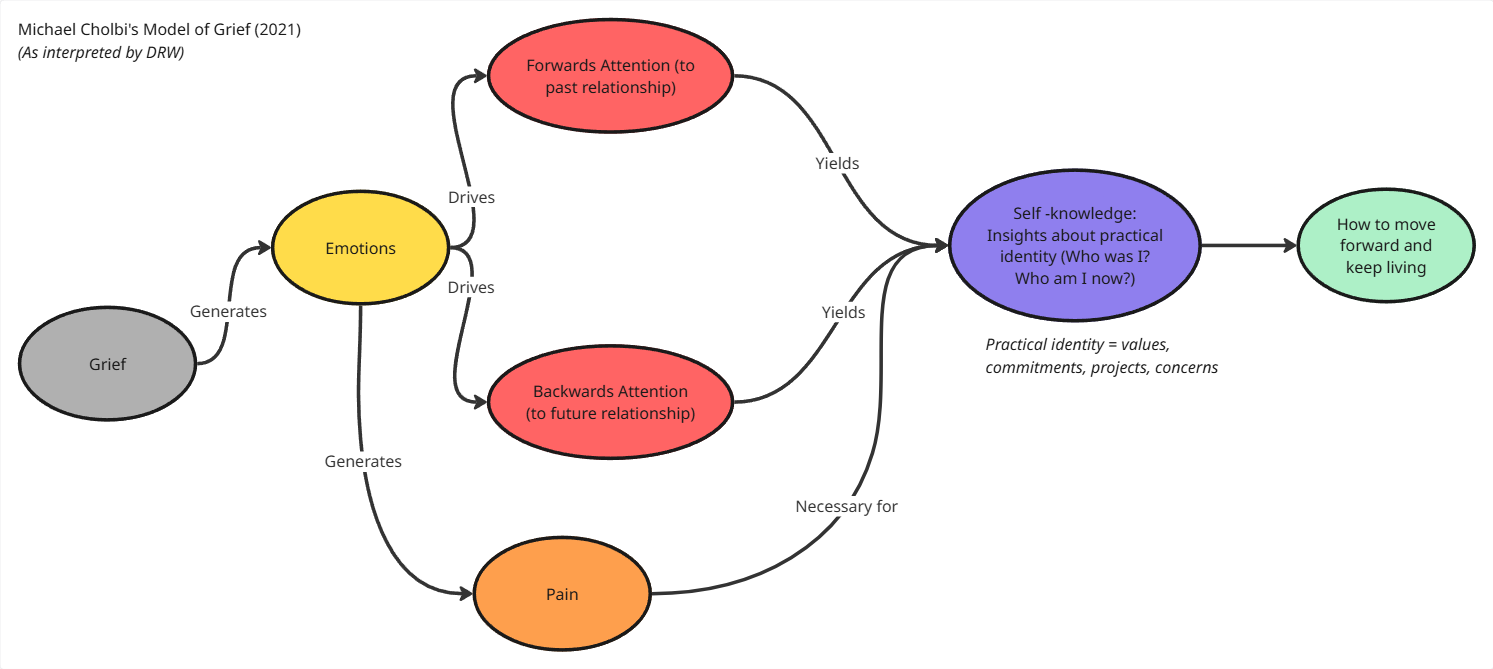
Both recognize that grief is a set of emotions, behaviors, and cognitive activities. However, while Worden’s conception creates a list of this set, Cholbi creates a model explaining how these connect. Specifically, Cholbi suggests that grief generates emotions, which drive our attention towards the past/future of our relationship with the deceased, which we purposefully engage in as an activity that yields insights about our practical identities. See the bottom of this list for the model.
Both Worden and Cholbi suggest that there is a way to go about grief healthily, and their views overlap somewhat.
Task 1 (Realize the loss) is similar to Cholbi’s discussion about attention. When our emotions drive our attention away from the death, we cannot emotionally accept that we have experienced the loss.
Task 2 (Process the pain) is similar to Cholbi’s suggestion that the pain is a causally necessary part of grieving healthily. If we disengage from the pain - by physically distancing ourselves, suppressing feelings, idealizing, or trying to just ‘get over it’ - we deny ourselves the opportunity to go through the pain and gain the self-knowledge that comes from it.
Task 3 (Adjust to life without the deceased) has internal and spiritual adjustment as part of it. For internal adjustment, we must ask ourselves who we are now that our identity is disrupted (because of the loss of the relationship that our practical identities were invested in, as Cholbi would say), and we will emerge from this with an adjusted sense of self. We have no choice but to do so, because the deceased person can no longer fulfill the same role in our practical identity. As for spiritual adjustment, our beliefs about the world are shaken, and the loss must be either accommodated or assimilated. Cholbi would say that the puzzle that grief creates includes the beliefs driven by that relationship, and we must resolve this as well.
Task 4 (Find a way to remember the deceased while embarking on the rest of one’s journey through life) involves finding activities to memorialize the person who was lost, maintaining the relationship while moving forward. Cholbi agrees that the relationship is not lost, and that this is a form of backwards attention (who were they to me?) and forwards attention (what do I want to be without this person?). We can memorialize the person and still form new relationships with others, reconfiguring our future lives.
Cholbi frames grief positively as both pain and opportunity - something we get to do - while Worden (understandably) frames grief as something we have to do. Because grief provides us such an expanse of experiences, the driven attention to reflect upon it, and is such a pivotal time in our lives, it is such a rich opportunity to understand ourselves. I wonder if it may be clinically valuable to (carefully and tactfully) frame grief in this light. Cholbi seems to think so, stating in his book that this recognition may be helpful for his grieving readers. In my clinical work, there is an idea that it is psychologically healthy of being flexible in moving towards and away from the things that matter to us. If we gently frame grief - something that matters greatly to us, painful as it is - in the way he describes, I wonder if this can build that psychological flexibility.
Cholbi distinguishes between grief and mourning as self-directed and public respectively. Worden’s implicit distinction between grief and mourning is along the lines of what happens to us (grief) versus what we do (mourning). I prefer Cholbi’s distinction because it fits better with my intuitions about these two concepts. So although I will refer to Worden’s Tasks of Mourning by name, I think he is really talking about the Tasks of Grieving.
I am curious about my readers’ experiences with grief and mourning. I am sure that many of my readers have experienced (or are experiencing) grief. As a complex and lengthy experience, the writing about it will always have difficulty doing justice to the experience of it. Do these ideas mirror your own perspective? Or differ them? How, if so? I would love to hear from you in the comments, in personal emails, or even by just chatting to me about it.
In Part 2 of this post (Media & Mental Health #1), we will examine grief in Clair Obscur: Expedition 33 (E33) with these concepts. My primary aim is to look at it through the lens of grief therapy by applying the WTM framework to its story by analyzing how and where the tasks of mourning are present in its plot. My secondary aim is to use the philosophical conception of grief to frame the story.
Stay tuned!
References
Cholbi, Michael. Grief: A Philosophical Guide. Princeton: Princeton University Press, 2021.
Worden, J. William. Grief Counseling and Grief Therapy: A Handbook for the Mental Health Practitioner. Fifth edition. New York, NY: Springer Publishing Company, 2018.